

Our vision on the impact of AI in consulting
We founded ST Strategy in June 2020. Months before that date, we weighed the pros and cons and conducted the various studies we deemed necessary to build our value proposition, give it meaning within the market we were targeting, and, in short, work on the fit between ourselves and our potential clients.
On November 30, 2022, ChatGPT was made public by its company OpenAI, and that is when a wave started that has only continued to grow to this day and has yet to reach land. What initially seemed like a curious «toy» with few direct applications (at the time) to the reality of businesses is proving its advanced capabilities more every day, to the point where we believe we can now announce that we are facing the white-collar revolution.
For just as coal and the steam engine from 1760 and electricity from 1870 triggered the first and second industrial revolutions respectively, AI is triggering a digital revolution — not so much in terms of business models, but in terms of job roles.
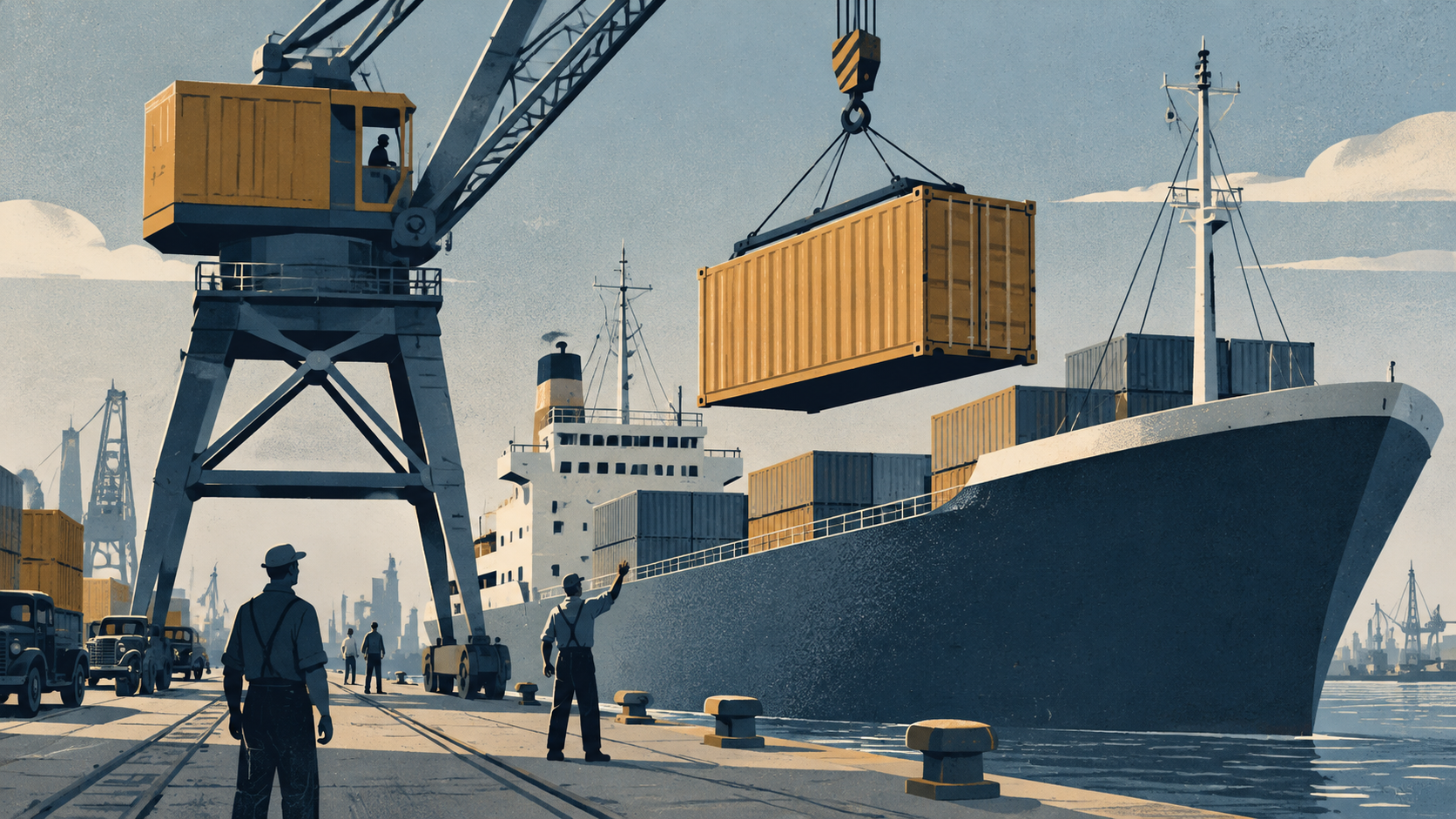
A few weeks ago at a talk on AI, Carolina Escribano, Customer Engineering Manager at Google, showed us an image of one of the first containers invented by Malcolm McLean being loaded onto a ship. That precise moment caused an enormous shake-up in the logistics sector. Ports had to adapt their infrastructure. Ports that had been first-tier — like Manhattan — fell behind for failing to invest at the required level, while others correctly read the moment and invested in what was coming, positioning themselves as the country’s leading ports, like New Jersey. The container represented a paradigm shift: ports no longer needed as many dockers — cranes were needed instead — and new job roles were created that had been unimaginable before, such as port crane operators or logistics planners.
A photo taken just over 70 years ago teaches us that companies need to adapt to the future and stop thinking about the past. That is what we try to do from our company. A market disruption like the one we are experiencing forces us to correctly interpret the future, or we will stop being competitive. This disruption is a major opportunity that can allow us to gain market share and compete on equal footing with larger players.

Changes we expect AI to bring
Artificial intelligence has proven to be highly useful, but we need to know how to identify when it truly is. What happens here is that many AI creations prove not to deliver real value, and we could enter the painkiller vs vitamin debate. And precisely for this reason, it is important to distinguish between operational tasks and strategic tasks.
Operations vs strategy
AI has proven to be very powerful when operating under automations and clear rules about how to proceed in each scenario it encounters with a dichotomy. Income invoices go into Excel A, expense invoices go into Excel B. It doesn’t fail. It does it perfectly. Therefore, in those scenarios where we have the comfort of knowing all possible outputs, we will have a robust tool that will work incredibly well.
But what happens in strategic situations? Here, our experience tells us that the consultant still beats AI. When we do strategy, we look for solutions that adapt in a changing environment, with a different team in each project, requiring empathy and with multiple variables within the company that change between projects. Here we cannot give clear rules.
- Repetitive and structured tasks
- Automations with clear rules
- Processing large volumes of data
- Generating standardised documents
- Strategic decisions with unique context
- Empathy and client management
- «Out of the box» thinking
- Adapting to unforeseen situations
Productivity
In the previous point we talked about the great utility that AI can bring to operational tasks. We don’t want to replace our team with a machine; what we want is for our staff to be able to dedicate their time to more complex tasks that bring more value to the company. Our approach is that AI is a tool that allows us to have a more productive and efficient team.
And this point can be linked to the costs of AI. There is a school of thought that tells us that the AI we use today is subsidised. The capital raised by the leading companies is being used to cover a significant part of the costs (Anthropic recorded operating losses of around $8 billion). When the growth rate slows down, the cost will end up being passed on to customers, and companies that have created dependency without preparing their cost structure could find themselves in serious trouble.
We must also bear in mind that in many cases the argument for using AI is the staff someone can save — but are we sure we are actually saving? If processes are not well standardised and automated, we may only be replacing one cost with another without achieving a better impact for our company.
Working with AI every day and the stress it can generate
Applying AI to the most operational and routine tasks means we are leaving only the most complex tasks — or those requiring more reflection — for our team. This ends up causing a faster sense of mental exhaustion. And if we also work on 2 or 3 difficult tasks simultaneously with AI, we are constantly reviewing what the artificial intelligence has prepared and jumping from one task to another. It is not easy to manage this pace. Rafael Casuso wrote about this in an article we recommend reviewing.

AI runs on data
This is one of the most obvious aspects on paper, but one that at the same time can imply an important revolution in companies’ operations.
For AI to give us the best-calibrated answers possible, it needs as much context as possible. This is where we apply the term Garbage In, Garbage Out. The worse the inputs we give the machine, the worse the outputs it will give us.
Companies now need to document all their activities and their daily interactions with their environment as thoroughly as possible, in order to convert as much tacit knowledge as possible into explicit knowledge. This was already an important factor before, but now companies will see even more direct value in doing it properly.
Client management
There are aspects of client management that will also be modified by the arrival of AI. On one hand, the client already takes for granted that we use artificial intelligence to carry out some of our analyses and, for a certain client profile, tries to use this as a price negotiation tool. The cost structure of consulting, however, does not necessarily have to be reduced.
This can be uncomfortable, but it is also an opportunity: it forces us to be more transparent, to better document the reasoning behind each recommendation, and to raise the level of what we deliver. Those who do their work well and know how to defend each conclusion with rigour will come out of this constant scrutiny stronger.
Another important aspect is that for every deliverable given to the client, it is very likely that they will verify it with their trusted AI. This will sometimes mean having to defend the same thesis more than once. In most cases, the tool will perform cold analysis, without the full context, and will therefore deliver biased conclusions.
Finally, Moravec’s paradox tells us that what is easy for humans is hard for machines, and vice versa. Machines have proven to be very good at calculation or information organisation tasks, but struggle with people management, empathy, and running a meeting. With this we want to point out that people are even more important for client management.
What the big consulting firms are saying
When we talk about how AI can change consulting teams, the question should not only be how many people we will need. As in the ports example, the change is not simply about doing the same work with fewer hands, but about rethinking how we organise ourselves.
The big consulting firms are already giving us some clues. According to Business Insider in January 2026, McKinsey had around 40,000 professionals and close to 25,000 AI agents. This shows that these tools are already part of how they work. It is not just about knowing how to use a tool, but about understanding how to integrate AI into the work and review what it produces.
Furthermore, Christoph Schweizer, CEO of BCG, explained in May 2026 that there was strong demand for AI at scale and that the firm had reoriented itself to help companies redesign functions, processes and team capabilities. At Bain, Christophe De Vusser placed AI and technology consulting at around 35% of their activity in March 2025.
For us, this reinforces the need to combine business knowledge, analytical capability and technological judgement within the team. Producing more content is not enough if we cannot afterwards explain why the conclusions make sense in that specific company.
The impact on teams
Here a question arises that concerns us particularly: how will we train the consultants of the future? If we delegate all the research, the initial analyses and the preparation of documents to AI, we risk removing from junior profiles part of the tasks through which they learn the trade. If we want good senior consultants tomorrow, we must continue training good junior consultants today. In 2008 the construction sector suffered a severe crisis. Eighteen years later, we find ourselves facing a shortage of qualified tradespeople, and construction companies cannot take on more projects due to a lack of staff. Do we want the consulting sector to follow the same path?
We must also not confuse incorporating technology with obtaining immediate results. Gartner offers a useful nuance: Gene Hall warned that the full benefit of transformation programmes could take a couple of years to fully materialise.
And this is where we need to talk about the Turing Trap (a concept coined by Stanford economist Erik Brynjolfsson in 2022). The trap tells us that we can apply technology for automation (dispensing with the human) or for augmentation (complementing the human and making them more productive). If we try to use AI to create a «clone consultant», we will end up falling into the trap. The success of new consulting models lies in increasing the consultant’s capacity — allowing them to analyse a larger amount of data or reach conclusions that previously required a much greater investment of time.
In short, our bet is not to replace a team of consultants with a set of tools. It is to build a team that knows how to work with these tools without losing knowledge, decision-making capacity, or responsibility for what it delivers. AI can be part of the process, but the judgement and commitment to the client must continue to be ours.

Where the opportunities lie
Throughout this article we have talked about changes, risks and the way AI is shaking up the consulting world. As we said at the outset with the example of the ports, those who understood the container as an opportunity went on to lead the sector. We believe the same will happen with AI.
The first opportunity is one of size. With AI, a small, well-organised team can carry out analysis, documentation and research at a level that was previously reserved for much larger structures. For firms like ours, this is a window we have never had before.
The second opportunity is accompaniment. Helping a company to distinguish in which processes AI adds value and in which it does not, to standardise before automating, and to prepare the cost structure for when AI stops being subsidised, is exactly the type of work we already know how to do in other areas. A few weeks ago, a reflection attributed to Mark Cuban was circulating on social media saying that if he were 20 today, he would start a consulting firm for small businesses. There are thousands of SMEs that will need a trusted partner to accompany them through this change.
And the last opportunity, perhaps the most valuable, is talent. If there is a risk that the sector stops training juniors, those who do it well will have an asset that others will not. Cross-checking data, detecting errors, arguing conclusions and understanding the client. These capabilities are not given by any tool — they are built through work.
Nobody knows exactly what the consulting sector will look like in five years’ time. What we do know is that AI is not a passing trend, and the opportunities will be for those who adapt — not for those who wait for the wave to pass. That is what we try to do from our company, and it is the path we recommend to all those who, like us, want to remain competitive in the market to come.