
Is the legal side relevant in an M&A (Mergers and Acquisitions) process? Should I get advice from the very beginning of my company’s creation? The answer is simple. YES, 100%
In an M&A process, the legal aspects are critical to ensure that the transaction is executed safely, efficiently, and without hidden liabilities.

Negotiation is a decisive part of the process, and having the best possible M&A advisor is our duty, but the legal structure helps lay the groundwork, clarifies the process, and, with good advice, resolves critical issues at difficult times, especially during the closing.
Legal advice from the company’s inception
Receiving legal advice from a company’s creation is not a luxury but an investment that prevents costly problems in the future. This ensures legal certainty, asset protection, attractiveness to investors, and future cost savings.
To list some of the main reasons, we could highlight:
| Reason | Why it’s important |
|---|---|
| Choice of corporate structure | Defines partner liability, taxation, and the ease of growing or attracting investment. |
| Well-designed shareholders’ agreement | Prevents conflicts between founders and regulates the entry/exit of partners, lock-in periods, and non-competition. |
| Intellectual property protection | Ensures that trademarks, software, catalogs, or content are registered in the company’s name, not individuals’. |
| Regulatory compliance | Prevents penalties related to GDPR, sector-specific licenses, commercial, and audiovisual law, ensuring legal operation. |
| Tax and financial optimization | Allows taking advantage of tax incentives (startups, R&D, audiovisual) and planning efficient structures. |
| Preparation for fundraising | Investors require a clean cap table, clear agreements, and protected assets to join the company. |
| Prevention of litigation and future costs | Avoids corporate, labor, or tax disputes; fixing mistakes later is much more expensive. |
Having the best M&A advice is the duty of every entrepreneur to ensure the success of the proposed transaction.

Legal advice in an M&A process
Legal advice in an M&A process goes through different phases, playing a relevant role in each one.
It is important to note that legal counsel is usually brought in when the process is already advanced. Previously, the advisory firm or M&A boutique has completed the entire documentation process with the company (Information Memorandum, Financial Plan, Valuation Approach, Screening of potential investors/buyers, and Teaser) and has identified the ideal candidates to carry out the transaction.
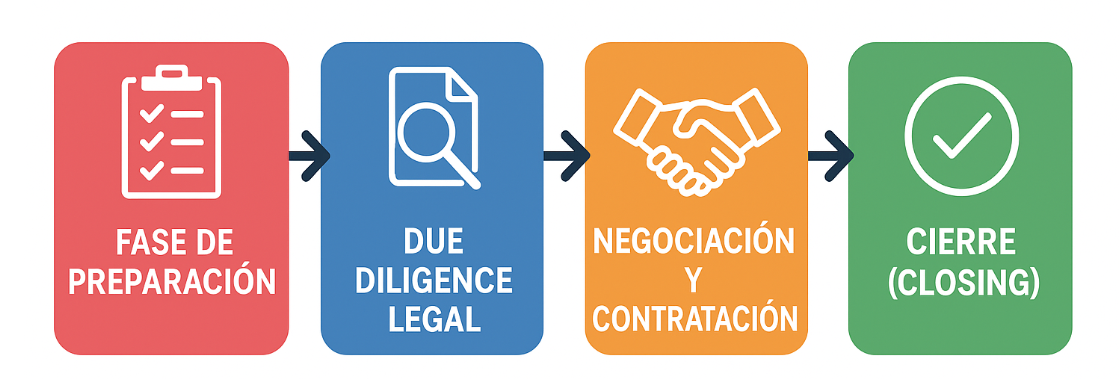
Once the legal figure is included in the process, the key aspects revolve around structure, due diligence, contracts, warranties, competition/regulation, and taxation, in addition to labor and corporate governance obligations.
The main points to consider are:
Transaction Structure
- Asset deal vs. share deal: buying specific company assets versus acquiring shares/stock.
- Mergers, acquisitions, or joint ventures: each with different legal, tax, and labor implications.
- Conditions precedent: requirements before closing (regulatory approvals, meeting financial milestones, etc.).
- Merger control: notification to the CNMC (Spain) or EU competition authorities if thresholds are exceeded.
- Sector-specific regulation: licenses and authorizations (telecom, audiovisual, financial, healthcare, energy, etc.).
Legal Due Diligence
- Corporate: bylaws, shareholders’ agreements, capital increases, compliance with corporate obligations.
- Contracts: change of control clauses, key contracts with clients, suppliers, and strategic partners.
- Labor: compliance with labor laws, hidden liabilities, applicable collective agreements, and potential severance payments.
- Tax: open inspections, tax risks, compliance with tax obligations.
- Intellectual and industrial property: trademarks, patents, licenses, copyrights.
- Litigation: ongoing lawsuits or potential judicial or arbitration contingencies.
Purchase Agreements (SPA / APA)
- Price and adjustments: closing mechanisms (locked box vs. closing accounts).
- Representations and Warranties (Reps & Warranties): seller’s statements about the company’s condition.
- Indemnities: coverage for undisclosed liabilities.
- Earn-outs: a variable part of the price based on future performance.
- Holdbacks or escrow accounts: a portion of the price held back as a guarantee.
Corporate governance and post-closing agreements
- Shareholders’ agreement: in case of co-investment, regulates drag-along, tag-along rights, reinforced majorities, etc.
- Non-compete and non-solicitation agreements: to prevent the seller from competing directly after the transaction.
- Retention of key managers: through retention agreements or incentives.
Labor and social aspects
- Transfer of undertaking: block transfer of employees (art. 44 of the Workers’ Statute in Spain).
- Union representation: obligation to inform/consult in certain cases.
Tax aspects
- Tax-efficient structuring: holding companies, leveraged buyouts, etc.
- Indirect taxes: VAT, Transfer Tax (ITPAJD), depending on the type of transaction.

Conclusion: Good legal advice is important at all times and for all company decisions, and it is indispensable in an M&A process
The legal part is not a mere formality to be completed. It is an essential part of the process that guides, structures, and defines the rules agreed upon by both parties. Good legal advice can tip the balance in our favor on certain points of the negotiation, while always ensuring its stability and proper execution.
It is important to emphasize that the legal advisor must have a feel for the process, meaning they must understand which “battles” we must win, which battles we can afford to lose, and which battles we must negotiate. This point is crucial for differentiating between potential legal advisory firms.